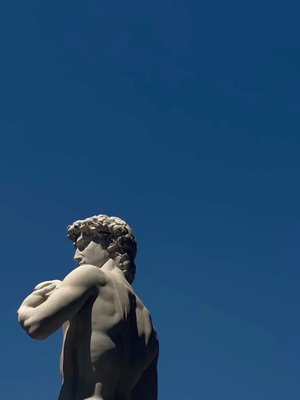
Trébellu: The argument for a new word to define true beauty.
Beauty, as the word we know, has lost it’s true meaning due to overuse. It’s definition is now built upon unstable sands. It’s become shallow. Anything is and can be beautiful now, from phones to sunsets. More often then not, the word leaves our lips before we’ve even registered the moment. People are beautiful. Habits can be beautiful. The word has lost it’s meaning, just like so many in the English language. From constant use, as is expected, we change the weight of meanings, the expectation of their impression is moulded by different situations. Thus, a discussion must be brought to the table about the creation of a new word. Trébellu. A new word for a more true kind of beauty. The quiet, unadorned type. The type that is not arrogant or egoistical. It’s simplicity speaks for itself and it needs no makers mark or branding to define it’s worth. With organic roots and leaves free from the poison of self-awareness, this form of beauty has a meaning far richer then we can comprehend by simply reading a book about it. It must, in all ways, be experienced. When the frost isn’t completely crisp, or when skies are all entirely grey. This is trébellu.
The prefix ‘Tré-’ comes from the Old English ‘tréowe’, meaning true, faithful, trustworthy; while also coming from the same root as tree, with implications of steady, firm and solid (from the Proto-Indo-European). Thus, the meaning is based on dependency and integrity. Like a tree, it is ancient yet young, slow to change, but consistent. It’s not exuberant in it’s display, but rather simplistic and natural. There is no possibility for it to be tarnished by artificial expectations for in it lies a rhythmic metronome that ticks internally; keeping it’s meaning steadfast and secure. While the suffix ‘-bellu’ is from the Latin ‘bellus’ meaning pretty, fair or handsome, with a deeper meaning of being connected to the concept of good (stemming from the Indo-European). Trébellu is an experience more than it is a definition. A moment in time that continues to exist beyond our noticing of it. It’s the feeling of a deep forest green, the texture of smooth stones, of damp, pine air. It’s beauty in it’s most ordinary display. If anything, it could actually be dishonouring, disrespectful, to define it by such regimented meanings we confine most of our lexicon to.
Through portmanteaus, we’re able to redefine the English Language from a healthier standpoint. However, there is a fine line that hasn’t been established yet. Though we are, and still do, create, blend and coin new words, the language we are creating currently is built upon an ocean of vacant meanings. By contracting and abbreviating to such an extreme degree, we are engraving into the very patterns of our tongues to say everything and mean nothing. We are in the midst of the era of speech with no thought. The modern essence of English has become quite literal. The landscapes we had for flexibility of meaning have sunk under the seas of rigidity. We’ve become quick to correct and amend misunderstandings. Our understandings and interpretations must be exact and precise in their motion. We create new words as quickly as the sunrises in winter yet the new words we are forming have little thought behind them. Through either contractions, abbreviated ambiguity, we’re unaliving the English Language letter by letter and falling into the dangerous lands of double speak.
The quote by Kenko, “Should we look at spring blossoms only in full flower, or the moon only when cloudless and clear” captures the panoramic notion of trébellu, and what the term beauty should actually refer to. Beauty has become a standard of unceasing perfection, a never-ending appearance of constant flawlessness. Yet, here Kenko dismantles the narcissistic pillars that society has positioned itself onto. Where billboards have been meticulously manipulating us with the American Dream and advertisements have been drip-feeding us dissatisfaction under the facade of achieving our goals. Through the metaphor of Spring; typically a season associated with new starts, the beginning of nature ‘perfecting’ itself, where everything is coming ‘alive’ again until the final climax of Summer. He challenges this preconceived notion we harbour about the season, where blossoms are only considered beautiful when in ‘full flower.’ Yet, the partially opened, or just the buds of the blossoms, are disregarded and considered even ugly. The metric we use to measure this is founded on such synthetic ideas, for who truly determines at what point the flower is beautiful? Kenko then further remarks that ‘the moon only when cloudless and clear?’ The use of the underlying contrast of light, from Spring, with the overarching darkness from the moon, highlights the duality that should beauty as a whole. Yet, we rarely utilise it in this aspect, we feel safer sticking to a static mono-meaning - as if we’re scared of the dynamic nature a word might hold. Furthermore, there is an element of fear over the incorrect use or pronunciation of words, thus we have pigeon holed ourselves into a vocabulary that doesn’t serve us. The ‘cloudless and clear’ further implies another perspective we hold about beauty. Clouds are typically viewed as an obstruction, an inconvenience, to a view. They inhibit us from see the beauty behind them, for surely they can’t be a part of the view itself. So stubbornly do we perceive the clouds as taking away from the beauty - rather than adding to it - that we criticise and critique as if we’re drink from the very fountain of omniscience itself.
Ultimately, one of the main concepts that Kenko is challenging is how beauty can’t be measured by static metrics, beauty exists as a constant flowing river, forever changing, yet steadfast in its ripple. It defies the standards we so vigilantly created. Beauty argues with our perfection and wages war against our flawlessness. The clouds cover our skies and the moon runs away from our judgemental eyes. The nature orientated language Kenko uses highlights the how true beauty, trébellu, actually exists and how it has been for years beyond our own. He is insinuating that beauty though it is young, is deeply ancient. In it’s ways lies wisdom forged by the hands of God, and is saturated in experiences that barely compare to our lifespans. It has existed before mankind could conceive even the word to describe it. Though, societies incessant need to climb higher, swim deeper, seek greater ends up pushing us down the mountain we so adamantly wished to climb up. Not only this, but the rich irony is then we end up abusing the very things that helped us get to the peak; only to realise it is not about the end but the journey.